You’ve got an amazing SaaS product, a talented team, and consistent traffic to your website. But there’s one problem: no one is clicking that magical “Sign Up” or “Request Demo” button.
If this sounds familiar, the issue likely isn’t your product — it’s the storefront you’re using to present it: your landing page. Many startups treat their landing page as a mere formality. But in reality, it’s the most critical conversation a potential customer will ever have with your brand. It’s a moment where you either win or lose — often within seconds.
In this guide, we won’t waste your time with cliché advice like “Write a good headline.” Instead, we’ll give you a proven, actionable system designed to turn visitors into loyal customers. It’s called the C.O.N.V.E.R.T. Framework, and by applying each step, you’ll build a scientifically backed landing page and enjoy the results as your conversion rate climbs.
What Is a SaaS Landing Page and Why Does It Matter?
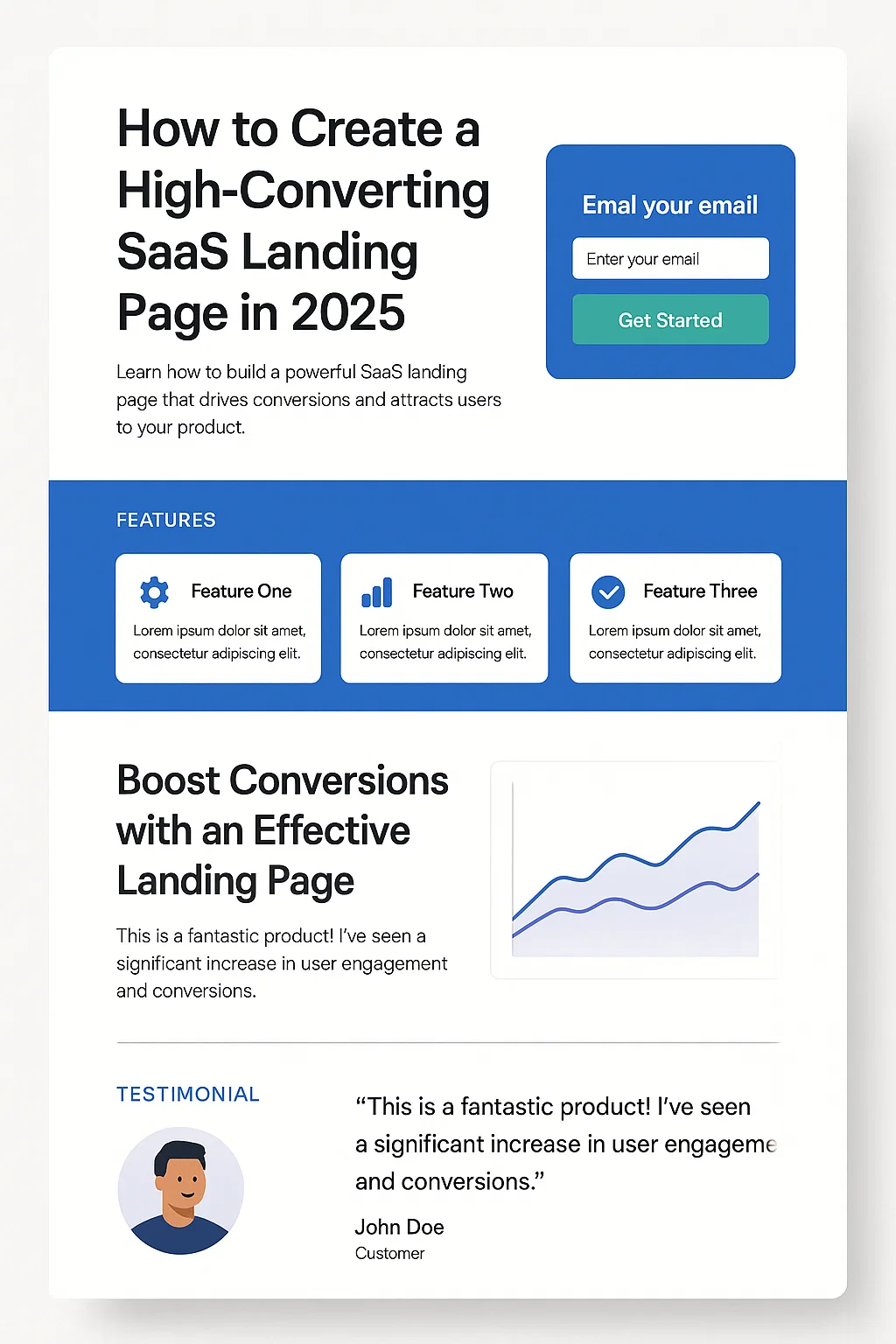
At its core, a SaaS landing page is a standalone web page with a singular focus, designed to greet visitors coming from a specific marketing or advertising campaign. That goal might be collecting an email address, starting a free trial, requesting a demo, or signing up for a service.
Unlike your homepage, the landing page doesn’t aim to introduce your company as a whole. It has one job: to convert.
Think of it as your best digital salesperson — working 24/7, never getting tired, giving the perfect pitch to every visitor. If that salesperson doesn’t know what to say, even the best leads will walk away.
[IMAGE: Comparison between a cluttered homepage full of distractions and a clean, focused landing page with a single CTA.]
Introducing the C.O.N.V.E.R.T. Framework: Your Formula for High Conversions
Years of data, thousands of A/B tests, and core marketing psychology principles reveal that high-performing landing pages share a common DNA. We’ve distilled these into a simple, memorable, and actionable model:
C – Clear Value Proposition: Make Them Say “This Is It!” in Seconds
When someone lands on your page, their brain immediately asks: “Is this for me, and what’s in it for me?” If you can’t answer that within 5 seconds, they’re gone. Your value proposition is the clearest and strongest answer to that question.
- Don’t say what you do. Say what problem you solve:
– No: “Project Management and Collaboration Platform”
– Yes: “Never Miss a Team Deadline Again” - Be Clear, Not Clever: Avoid jargon. Use language even your mom would understand.
- Highlight the Outcome: Show the end goal or the emotional relief your user will experience.
Pro Tip: Say your value prop out loud and have someone ask, “So, what do you do?” If they can explain it clearly after hearing it once, you’re on the right track.
O – Optimized, Focused Design: Remove the Noise, Amplify the Signal
The best landing pages are boringly simple. Every element exists to guide the visitor toward your Call to Action (CTA). This is called the Attention Ratio in marketing. Your goal? Always 1:1 — one page, one goal.
- Remove the Nav Menu: Don’t give people escape routes. You don’t want them clicking “About Us” or “Careers.” You want them completing a single action.
- Create Visual Hierarchy: Your most important element (usually the headline) should be the largest and most eye-catching. Design a natural flow where the eye follows headline → supporting copy → image → CTA button.
N – No-Brainer CTA: Make the Click Irresistible
Your CTA is the climax of your page. A weak, vague, or boring CTA will sink even the best design.
- Be Action-Oriented: Avoid generic labels like “Submit” or “Click Here” Instead, show the benefit.
– No: “Sign Up”
– Yes: “Start My Free Trial” or “Download My Strategy Guide” - Use Contrast: There’s no “best” button color — only the one that stands out most on your page. The CTA should visually pop.
-
Place It Right: Your CTA should be visible both above the fold and again at the end of the page.
V – Validation Through Trust Signals: Eliminate Doubt
People are naturally skeptical about giving money or data to companies they don’t know. Trust signals are the visual proofs that eliminate this doubt.
- Social Proof: Client logos, testimonials, case studies, and lines like “Join 10,000+ happy customers” are powerful.
- Security Badges: If you accept payments, display SSL, antivirus, and other trust markers.
- “As Seen In”: If your product was featured in a major publication, showing those logos instantly boosts credibility.
Pro Tip: The most effective testimonial shows a specific before-and-after story.
Yes: “We saved 5 hours a week thanks to Feature X”,
No: “Great product!”
E – Effective Copywriting: Words That Turn Visitors Into Users
If design is the skeleton, copy is the soul. Great copy speaks to both logic and emotion.
- Sell Benefits, Not Features: People don’t buy features. They buy what those features do for them.
– No: “10 GB Cloud Storage”
– Yes: “Access all your important files, anywhere, anytime” - Speak to “You”: Say “You” instead of “Our platform.” Center everything around the customer and their pain.
- Use the PAS Formula:
– Problem: Name their pain
– Agitate: Show why it hurts
– Solve: Present your product as the fix
R – Real-World Application: Build Your Landing Page Step-by-Step
You’ve got the theory. Here’s how to apply the C.O.N.V.E.R.T. Framework in action:
Step 1: Understand the Job Your User Wants Done (Jobs-to-be-Done)
Customers don’t “hire” your tool — they use it to solve a specific job. Slack doesn’t sell “chat.” It helps teams communicate with fewer emails. Once you grasp the job, your messaging will fall into place.
Step 2: Turn Your Headline Into a Magnet
Use the value proposition rule to craft your main headline. The subheadline should clarify or reinforce the benefit.
Step 3: Strategically Show Social Proof
Place recognizable client logos right under the headline. Put your strongest, results-based testimonial near the CTA.
Step 4: Craft an Irresistible Offer
Your free trial or demo offer should carry real value. Reduce friction: say “No credit card required” or “Cancel anytime.”
Step 5: Form Design: Less Is More
Every extra field lowers your conversion rate. Start by asking only for the essentials — often just an email address is enough.
Test, Measure, Optimize: The Path to Perfection
A high-converting SaaS landing page isn’t “set it and forget it.” It’s a living, breathing asset that needs constant improvement. That’s landing page optimization.
A/B Testing Basics: What Should You Test?
A/B testing lets you compare two page versions and see which performs better. Always test one element at a time. Test ideas:
-
Your main headline
-
CTA button text and color
-
The main image or video
-
Your offer (e.g., “14-day trial” vs “30-day trial”)
Key Metrics: What Should You Track?
-
Conversion Rate: % of visitors who take your desired action
-
Bounce Rate: % who leave without engaging. A high rate may mean unclear messaging.
-
Time on Page: Indicates engagement level
-
Lead Quality: How many free trial users become paying customers?
It’s Time to Act. Land Your SaaS Product Now!
Creating a high-converting SaaS landing page isn’t art — it’s science. By following a proven system like the C.O.N.V.E.R.T. Framework, you replace guesswork with control.
Use this guide as your checklist. Audit your current page against these principles or build your next one with this foundation in mind. And remember — every visitor is an opportunity. Make sure your landing page captures that opportunity every single time.