

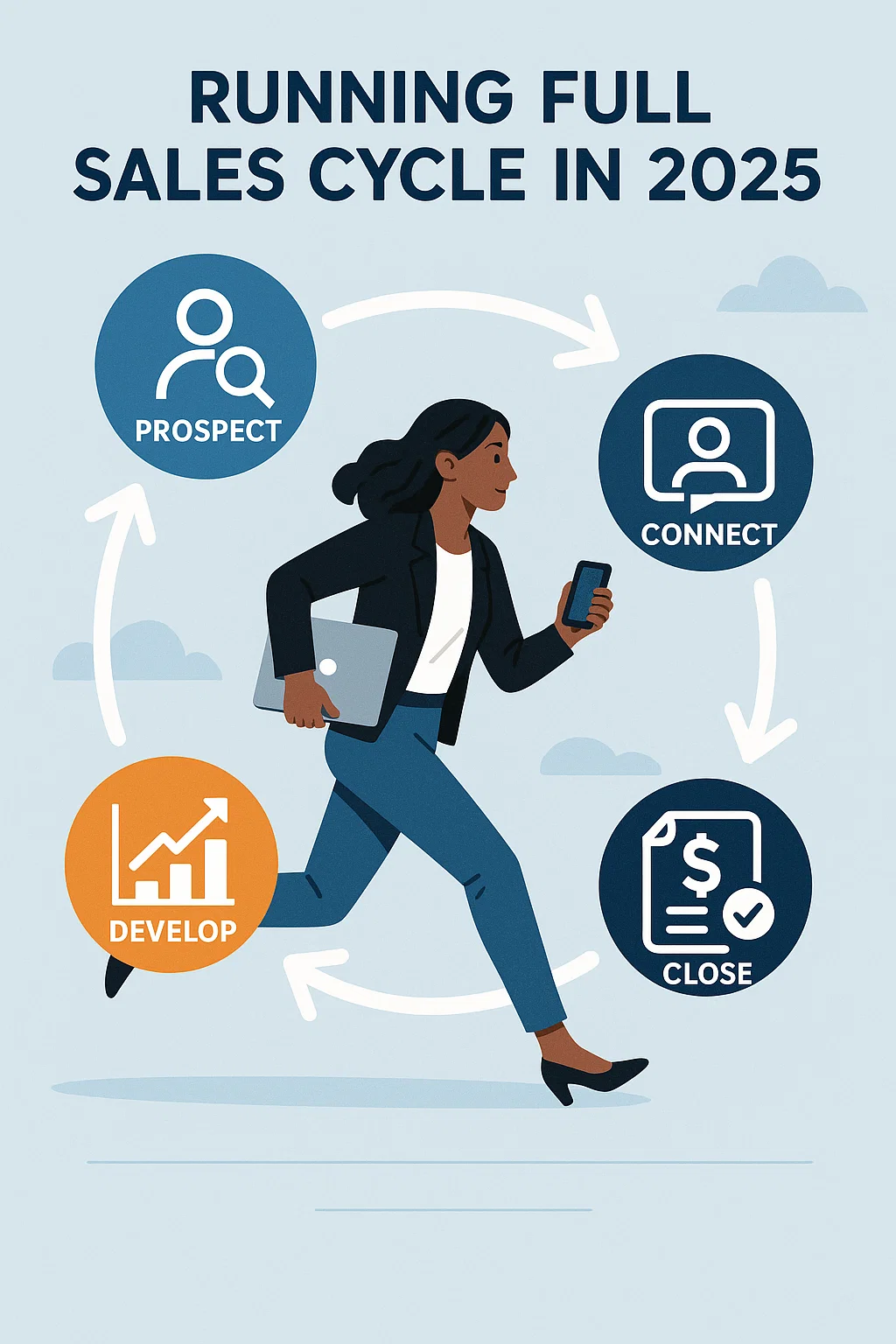
Reaching quotas and passing leads from team to team like a relay baton are no longer the only aspects of sales. You must think in cycles rather than silos if you’re serious about expanding your business-to-business pipeline, especially within swiftly changing industries such as SaaS. Full sales cycle offer assistance with that.
Full sales cycle means that you’re taking the full responsibility of the whole process till the customer signs the contract (and even beyond). The goal here is to create a perfect experience where your sales team leads the entire process, not just ‘handing off.’
Full-cycle sales may provide the clarity you need, whether you’re a growing team attempting to scale your process or an early-stage startup creating your first GTM motion.
Roles: SDR, BDR, AE
To make things clear, a full cycle doesn’t mean a single person handling everything. Here, transparency is the key point. Specialized positions like SDRs (Sales Development Representatives), BDRs (Business Development Representatives), and AEs (Account Executives), a full-cycle system can be operated. These roles are components of a cohesive machine, meaning, they are not separate from each other.
The top of the funnel is often handled by SDRs. Initial outreach, qualifying and even reawakening cold accounts are in their responsibility.
BDRs are more concerned with outbound hunting (making calls, networking, targeting).
AEs take over when a lead exhibits promise. They oversee negotiations, provide demos, and seal the deal. The common objective here is advancing the transaction.
Everyone has the same context and objectives in a full-cycle setup. Saying, “I passed it, it’s their problem now,” is definitely not an option. Rather, every role contributes insights to the next, generating a feedback loop. Your SDR is establishing the tone for the entire relationship, not just scheduling a meeting. The AE already knows the buyer’s pain points, so they don’t just show up.
Metrics & Milestones
You must be as deliberate with your numbers as you are with your people if you are running a full sales cycle operation. Metrics are important because they enable you to identify issues early and scale what works, not because they sound good in board meetings.
Full cycle tracking involves monitoring more than just monthly sales at the end of the month. Demo-to-close conversion rates tell you a lot about whether your representatives are closing qualified opportunities or are they just filling their calendars with pointless telephone calls.
Another important metric is time-to-close. Something is wrong if deals are taking weeks to complete.
The pipeline stages come next. Do prospects routinely stall following demos or disappear after submitting a proposal? That indicates that your messaging isn’t reaching your intended demographic.
Also, lead response time is more important than most teams realize. Speed is superior when intent is high. It is more probable that a conversion decreases with each hour of waiting.
Lastly, the AE win rate by lead source. Some channels attract serious buyers, while others simply take up the time of your team. Being aware of the distinction makes it possible for you to focus on your efforts where they are most needed.
1. What does full sales cycle really mean?
Fundamentally, full sales cycle refers to ownership. It demonstrates that your sales team is doing more than simply responding to marketing’s messages or hoping a handoff goes smoothly. From the initial cold email to the last DocuSign click, it involves shouldering responsibility for what comes out.
You’ll be aware that you’re operating at full capacity when:
- Solid qualification, not just volume for the sake of volume, is reflected in your demo rate.
- Because you are establishing trust throughout the process rather than reestablishing rapport at each point, your close rate increases.
- Because full cycle representatives are more strategic in their sales and have a deeper understanding of the customer journey, your average deal size increases. Selling smarter is more crucial than selling harder because you know the consumer better at every level.
2. How do you scale a process-heavy sales system?
Pushing volume and burning out your reps are definitely not the keys to scaling ful sales cycle. It involves developing scalable processes for every stage of the sales process.
Here’s what makes scaling easier:
- Charting the entire sales process: Understand each step, including the cold email, discovery, proposal, and follow-up. Put it in code. Record it. Make it better.
- Not just pipeline size, but pipeline velocity as well: The number of deals you’re juggling isn’t important. It has to do with how quickly and smoothly they are progressing.
- Making the right automations: When achievable, use templates for emails, sales sequences, and CRM automations so that your representatives may concentrate on selling rather than administrative tasks.
- Contextual training, not merely calls: Develop your team’s ability to make connections, ask more detailed questions, and guide the client experience.
In full sales cycle, sales and marketing alignment is essential. Both teams must work together on everything.
What functions, then? Lead magnets that draw in the right people rather than just filling your CRM, email sequences, and case studies that address genuine objections.
Only when marketing provides sales with relevant, purpose-driven content does full-cycle work. No nonsense. Not a single vanity metric. A decision is just a step closer with fuel to move.
Content should appear, respond to actual buyer inquiries during demos, securely connect MQL and SQL, and provide dependable support when intent is high. You get results only when marketing and sales talk at the same frequency.
Running full sales cycle is clearly about cooperating to accomplish it more successfully.
Do you wish to build a machine with obvious scalability? Reach out to us!