

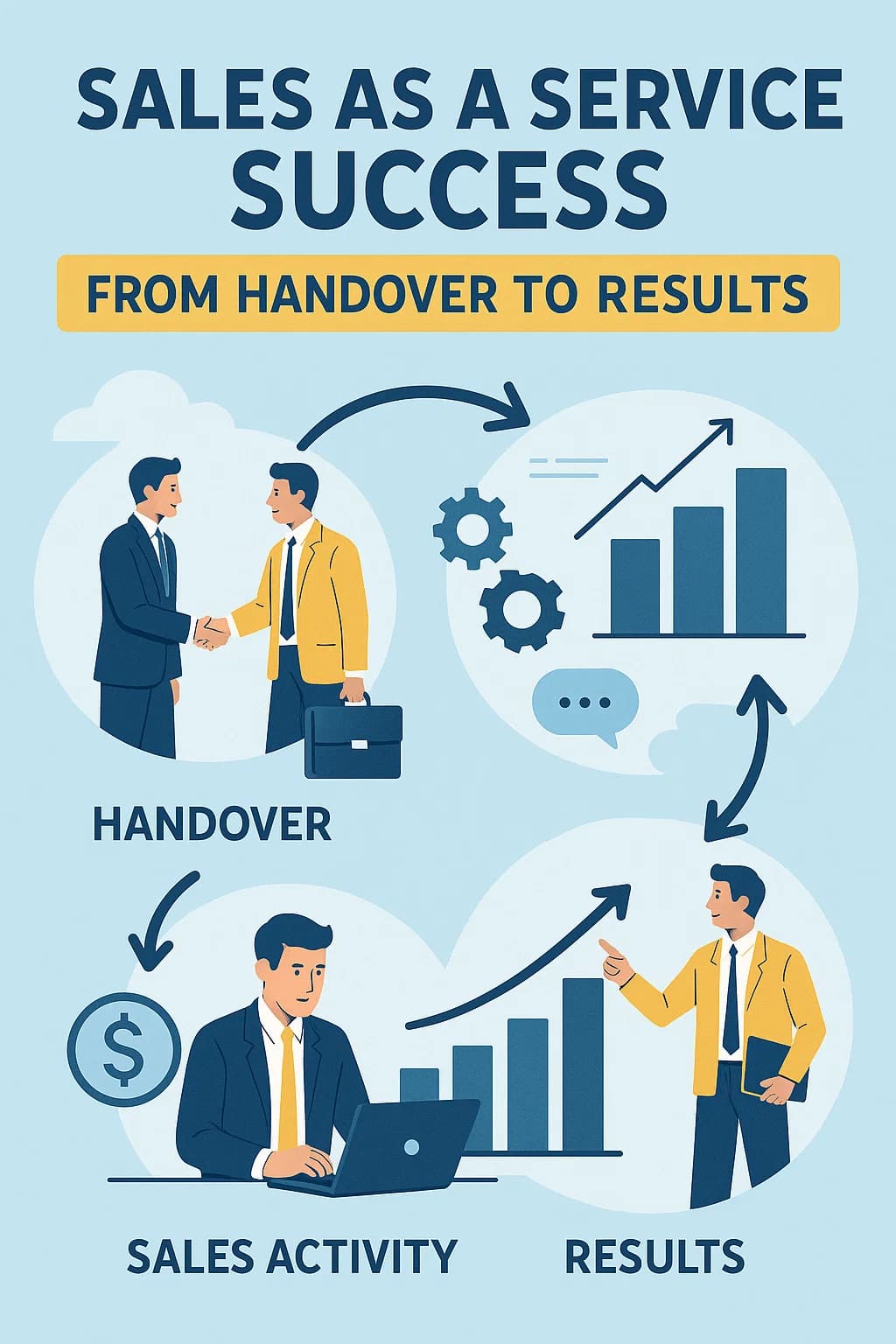
Sales outsourcing success is rarely decided by the provider you choose. Whether a sales as a service engagement pays off is decided in the first 90 days after you sign: what you hand over, how you define a qualified meeting, how often you review the numbers together and what happens when they slip.
Outsourcing sales is no longer unusual: half of the executives in Deloitte's 2024 Global Outsourcing Survey use outsourced services for front-office work such as sales, marketing and R&D. When an engagement fails, the cause is often visible early: nobody wrote down what success means.
Still deciding whether to outsource? Start with what sales as a service is and when it fits. This guide covers what comes after: the handover, a week-by-week onboarding plan, a weekly routine, the KPIs worth tracking and when to escalate or end.
What does sales outsourcing success look like?
Success is a steady flow of qualified meetings, at a cost per meeting you can afford, that turns into pipeline your team can close. Emails sent and calls made are inputs: they show that work is happening, not that it is working.
Split the result by who controls what. The provider controls the target list, the messaging, the sending setup, the volume and how meetings are qualified. You control the offer, the price, how fast you follow up and, unless the provider runs the full sales cycle, how well the meetings go.
The split matters because meetings are not deals. From more than 2.5 million recorded sales conversations, Dixon and McKenna report in Harvard Business Review that 40% to 60% of deals are lost not to a competitor but to buyers who say they want to buy and then fail to act. A provider can fill your calendar, but it cannot make an undecided buyer sign; see deals that stall on no decision.
What to hand over to an outsourced sales team
The handover sets the ceiling for the first quarter. Put these in writing before kickoff:
- Ideal customer profile. Industries, company sizes, countries, the roles that decide or influence and clear reasons to disqualify. Our guide to IT sales leads shows how to qualify them.
- What counts as a qualified meeting. For example: it takes place, the company fits the profile and a decision-maker or influencer attends, signed off by both sides.
- Messaging, proof and objections. Your positioning in two sentences, customer results you may mention, claims and price terms that are off-limits, and the objections you hear most, with answers that work.
- CRM and calendar access. A limited user in your CRM, booking links and a do-not-contact list of customers, open deals and partners.
- Markets and rules. The countries you sell into, because rules differ: in the Czech Republic, commercial email needs the recipient's consent in advance even between companies, with a narrow exception for existing customers, as the Czech data protection office explains.
- Rules for AI. What the provider automates and who checks AI drafts. Under Article 50 of the EU AI Act, applicable from 2 August 2026, an AI system that talks to prospects directly must be designed so they know it is an AI, unless that is obvious.
The first 90 days: a week-by-week onboarding plan
A structured program follows a predictable rhythm: the first qualified meetings usually land between week 3 and week 5, once new sending domains have warmed up and messages have been tested.
| Weeks | What happens | Owner |
|---|---|---|
| 1 to 2 | Kickoff, handover pack, profile and meeting definition signed off, CRM access, domains set up | Both; you sign off |
| 2 to 3 | Domain warm-up, target list, first sequences tested at low volume | Provider |
| 3 to 5 | First meetings; your team scores each one within 48 hours | You and the provider |
| 6 to 10 | Segments and messages tuned on feedback, volume raised | Provider, with your approval |
| 11 to 13 | 90-day review: cost per qualified meeting, opportunities, next-quarter plan | Both |
Two parts of the plan are not negotiable. The first is warm-up: Google's email sender guidelines ask senders to keep the user-reported spam rate below 0.1% and never reach 0.3%, and bulk senders to set up SPF, DKIM and DMARC. They cover personal Gmail accounts, not company Workspace mailboxes, but make a sensible floor for B2B; see why cold emails go to spam.
The second is patience. RAIN Group's research found it takes an average of 8 touches to get a first meeting with a new prospect, so a two-week-old sequence has barely started. Judge messages early on replies and meeting quality, and the program at the 90-day review.
How to manage an outsourced sales team week to week
Managing an outsourced team takes less time than managing your own reps, but not zero. Name one owner on your side, usually the founder or head of sales, and budget two to four hours a week. Then hold a 30-minute call every week with the same agenda:
- Numbers against plan. Booked, held and qualified meetings, this week and month to date.
- Meeting feedback. Each meeting from the past week marked qualified or not, with a one-line reason.
- Tests. Which segment, message or channel is being tested, and what the data says.
- Blockers. Anything waiting on you: approvals, content, calendar slots, answers for prospects.
- Next steps. What changes, who does it and by when.
Once a month, review the cost per qualified meeting and how many meetings became opportunities; once a quarter, decide which markets to keep or drop and whether to scale. Keep the numbers in your CRM, not in slides; our guide to sales pipeline management covers stages and reviews.
Fast feedback matters most: if your team takes a week to reject a meeting, the provider books more like it in the meantime.
Outsourced sales KPIs: booked, held and qualified meetings
The core KPI is the qualified meeting, best seen by counting meetings in layers. Martal's appointment setting guide separates booked meetings (the lowest threshold), held meetings (no-shows removed) and held meetings that are qualified (the company fits your profile), with opportunities created as the closest proxy for pipeline value.
Its worked example shows why. A program costing USD 24,000 a month books 20 meetings. At a 75% show rate, 15 are held; at a 60% qualification rate, 9 qualify. That is USD 1,200 per booked meeting, USD 1,600 per held meeting and USD 2,667 per qualified meeting: the same spend, more than twice the unit cost, depending on what you count.
| KPI | How to calculate it | What it tells you |
|---|---|---|
| Booked meetings | Meetings put on the calendar | Whether outreach creates interest |
| Show rate | Held meetings divided by booked meetings | Whether bookings are real |
| Qualification rate | Qualified meetings divided by held meetings | Whether targeting fits your profile |
| Cost per qualified meeting | Monthly cost divided by qualified meetings | What the program really costs |
| Meeting to opportunity | Opportunities divided by qualified meetings | Whether meetings become pipeline |
The pricing model decides which layer a provider works toward. Martal notes that pricing tied only to booked meetings rewards volume, not outcomes, so compare sales outsourcing pricing models before you sign and check what B2B sales outsourcing really costs in 2026 per qualified meeting.
Who owns the data, domains and CRM?
You should. Contact lists, CRM records, call notes, sequences and sending domains created for your program belong to you and should stay with you when the contract ends: settle it in the contract, not at the exit.
- Work in your CRM. Give the provider a user in your system instead of taking exports from theirs, so the history, sequences and notes stay with your team.
- Register domains in your name. Sending domains and inboxes bought for the program sit in your account, with the provider as an authorised user.
- Sign a data processing agreement. If the provider processes prospect data on your behalf, it is a processor under the GDPR, and Article 28 requires a contract that, among other things, obliges it to delete or return all personal data at your choice when the service ends.
Roles can differ, for example when a provider brings its own contact database. This is general information, not legal advice; check your case with your own counsel.
How to escalate when outsourced sales results slip
Agree the escalation path at kickoff, while everyone is still friendly, so a missed week triggers a process instead of an argument.
- Level 1: the weekly call. Raise the gap with data and agree one fix, an owner and a date.
- Level 2: a written recovery plan. If the gap repeats two weeks running, or a month closes below the guarantee, the provider's delivery lead puts the cause, the changes and a date in writing.
- Level 3: the contract. If the plan fails, use what the contract gives you: a shortfall carried into the next month, credits or an exit at the end of the minimum term.
Some problems skip the ladder: a spam rate climbing toward Google's 0.3% line, a prospect complaint, a data protection request, a message promising something you do not sell or contact with anyone on your do-not-contact list. Pause the affected sequence the same day, then find the cause.
When to end an outsourced sales engagement
End it when the program has had a fair test, at least the 90 days of the plan above, and still does not work, or when it has worked well enough to bring in-house. Signs that it is not working:
- Qualified meetings stay below plan after two written recovery plans.
- The provider cannot or will not explain its own numbers.
- Meeting quality does not improve after a month of scored feedback.
- Access to your own data is delayed or restricted.
The better reason to end is success. Once you know which segment, message and channel work, and the volume would keep a full-time person busy, hiring makes sense. Plan an overlap: The Bridge Group's 2025 SDR research found an average ramp of 3.0 months, an average tenure of 1.9 years and median annual attrition of 40%. Our page on outsourced sales vs an in-house SDR lays out the trade-offs.
Either way, exit cleanly: give notice as agreed, export everything from the CRM, move any domains not yet in your name, hand over open conversations and booked meetings, and get written confirmation that personal data was returned or deleted.
Frequently asked questions
How long does sales outsourcing take to show results?
In a structured program, the first qualified meetings usually land between week 3 and week 5, after domain warm-up and message testing. Replies and early meeting quality show up sooner. A fair verdict takes about 90 days, which is how long it takes to see which meetings turn into real opportunities.
Which KPIs should I track for an outsourced sales team?
Count meetings in layers: booked, held and qualified. Then add the show rate, the qualification rate, the cost per qualified meeting and the share of qualified meetings that become opportunities. Emails sent and calls made show activity, but they should never be the basis of a guarantee or a renewal.
How much time does managing an outsourced sales team take?
Plan for two to four hours a week from one named owner on your side. That covers a 30-minute weekly call, taking or joining the meetings and scoring each one within 48 hours, plus a monthly review of cost and conversion and a quarterly review of markets and scale.
Who owns the leads when an outsourcing contract ends?
You should, and the contract should say so: contact lists, CRM records, notes, sequences and sending domains created for your program stay with you. If the provider processes prospect data for you, GDPR Article 28 requires a contract under which it deletes or returns all personal data at your choice when the service ends.
Sales as a service success starts in the contract
Most of this can be agreed before the first email goes out, and our Sales Engine plans are built that way: the ideal customer profile is agreed in writing before the start, and a meeting counts as qualified only if it takes place, with a company matching that profile and a decision-maker or influencer present.
Every plan guarantees a monthly number of qualified meetings: 5 on Launch (1,750 euros a month), 10 on Traction (2,900 euros) and 15 on Scale (4,900 euros), and a shortfall carries into the next month at no extra cost. Compare them on our pricing page, see how we run lead generation and IT sales outsourcing, or start with sales strategy development if your ideal customer profile is not written down yet.
Sources and further reading: Deloitte, Global Outsourcing Survey 2024; Harvard Business Review, on customer indecision; ÚOOÚ, Act No. 480/2004; EU AI Act, Article 50; Google, email sender guidelines; RAIN Group, touches needed for a first meeting; Martal, appointment setting cost; GDPR, Article 28 on processors; The Bridge Group, SDR Models, Motions and Metrics 2025.