

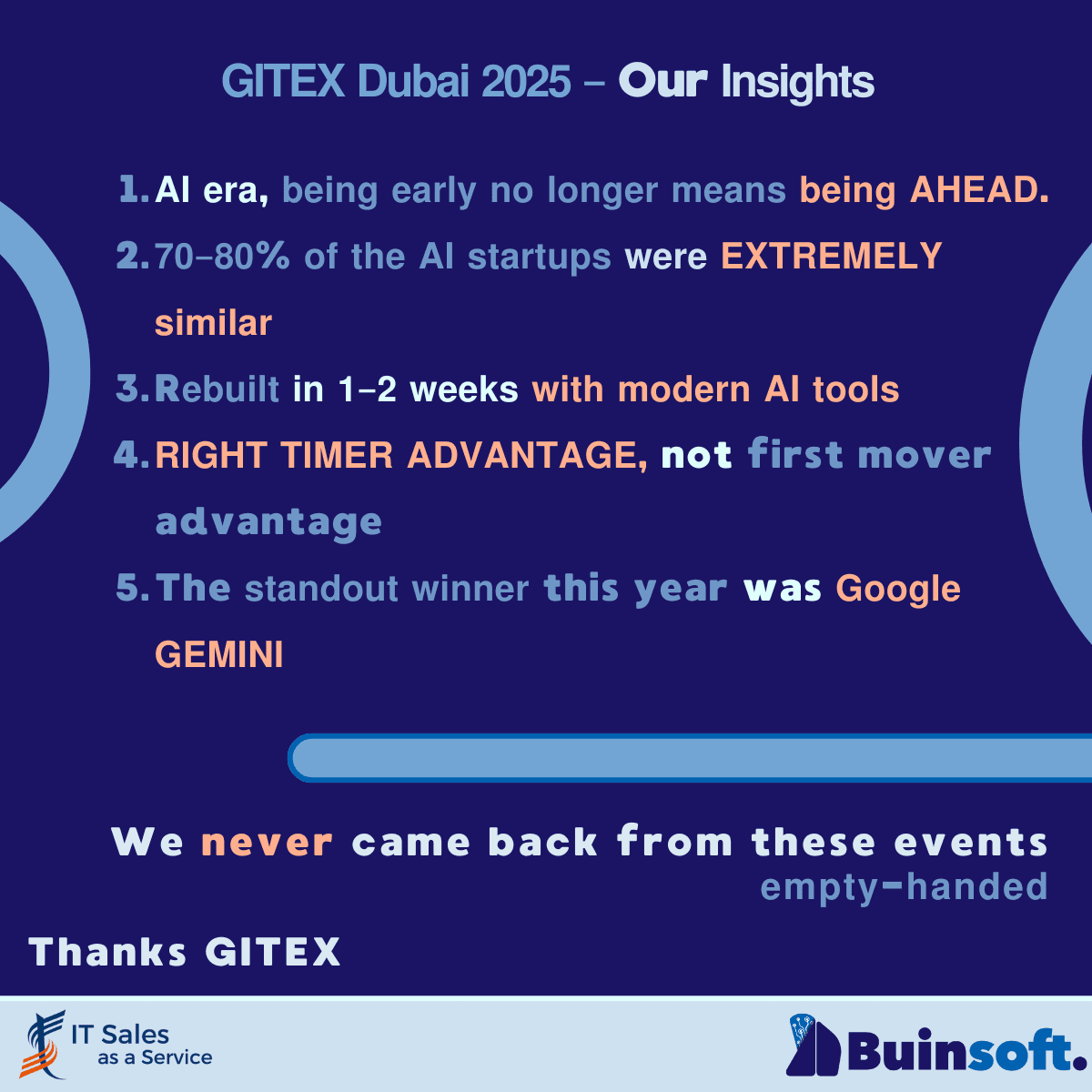
GITEX Global 2025 ran from 13 to 17 October 2025 at Dubai World Trade Centre, and it was hard to find a stand that did not promise something with AI. We walked the halls, sat through demos and talked to founders. One lesson stood out: in AI, being early no longer means being ahead.
Almost a year later, that lesson matters more. Below you get the verified facts about the show, then practical advice for selling an AI product to businesses: timing, market fit, pilots that become contracts and a message that stays current.
GITEX Global 2025 at a glance: dates, venue and scale
GITEX Global, organised by Dubai World Trade Centre, calls itself the world's largest tech and AI event, and 2025 was its 45th edition. The figures below are the organiser's own, from its closing press release of 17 October 2025.
| Item | GITEX Global 2025 |
|---|---|
| Dates | 13 to 17 October 2025 |
| Venue | Dubai World Trade Centre |
| Startup show | Expand North Star, 12 to 15 October 2025, at Dubai Harbour |
| Scale | More than 6,800 exhibitors, including 2,000 startups from 180 countries, and 1,200 investors |
| Next edition | 7 to 11 December 2026, Dubai Exhibition Centre, Expo City Dubai |
In 2026 the show moves to a new venue and format: a one-day summit on 7 December, then the exhibition from 8 to 11 December.
Why so many AI products at GITEX looked the same
Because, from what we saw, most were built on the same few foundation models for the same few use cases. Customer support bots, voice assistants and AI agents for WhatsApp or website chat filled stand after stand, and the difference often came down to the interface.
That is a sales problem, not only a technical one. Many pitches sounded written for investors rather than buyers: plenty of copilots and agents, little about the business result. When five vendors promise the same thing, buyers cannot tell them apart, so they compare on price or they wait.
Waiting is the bigger risk. Analysing more than 2.5 million recorded sales conversations, Dixon and McKenna reported in Harvard Business Review that 40% to 60% of deals are lost not to a competitor but to customers who intend to buy and then fail to act. Sounding like everyone else gives buyers one more reason to do nothing, as we explain in why B2B deals stall on no decision.
Is first-mover advantage dead in AI?
Not dead, but it rarely lasts. Being first still brings early customers, data and learning. It no longer brings a lead that holds, because a competitor can assemble a similar product from the same models and tools, often before your first round of demos is over.
Research explains why. In Harvard Business Review, Fernando Suarez and Gianvito Lanzolla argued that the payoff of being first depends mostly on two forces no company controls: how fast the technology changes and how fast the market grows. When both move slowly, first movers have their best chance of a lasting lead. When both move fast, durable first-mover advantages are very hard to win, and products age quickly as new entrants bring newer versions.
AI sits in that fast corner. Models keep changing, and adoption is rising: Eurostat reports that 20.0% of EU enterprises with 10 or more employees used AI in 2025, up from 13.5% in 2024. So we talk about a right-timer advantage instead: the winners adapt fastest to new capabilities and to what their buyers are ready to use.
When is the right time to sell an AI product?
When a specific segment is ready to buy and already knows you. Timing is about the buyer's readiness, not your launch date.
Readiness varies by segment. Eurostat's statistics on AI use in enterprises show that 62.52% of EU companies in the information and communication sector used AI in 2025, against 20.0% of all enterprises. A tool sold to IT firms meets buyers who already run AI; sold to a traditional industry, it must first educate the market, which means longer cycles and more proof.
Being known early matters just as much. The 6sense 2025 B2B Buyer Experience Report found that 95% of the time the winning vendor was already on the buyer's day-one shortlist, and four out of five deals went to the vendor favoured before first contact. Buyers also research with AI now: Forrester reports that 94% of business buyers use it during their buying process, as we cover in selling when AI builds the shortlist.
Signs that the timing is right:
- Buyers already use AI and ask about integration, not about whether AI works.
- A trigger is present, such as a new budget, a new leader or a failing process; signal-based selling shows how to track these.
- Someone owns the problem and can say what it costs today.
- First calls end with a concrete next step.
How to prove market fit for an AI product
Show the business result in the buyer's own numbers and let usage prove the rest. Buyers rarely care which model sits under your product; they care about return on investment, time to value and reliability. The model will change anyway, so tie your story to results that survive a model swap.
Proof now has to convince finance too. G2's 2026 Buyer Behavior Report, a survey of more than 1,000 B2B software buyers, found that finance involvement in software decisions jumped from 31% to 46% in a single year, and nearly half of buyers said their CFO had vetoed an already approved deal in the last year.
Market fit shows up in behaviour, not in applause at a stand:
| Signal | What it tells you | Warning sign |
|---|---|---|
| Pilots convert to paid contracts | The problem is worth paying to solve | Pilots end with 'maybe next year' |
| Usage holds after the first month | The product fits into daily work | Use drops once the novelty fades |
| Buyers describe the value in their own words | Your positioning is clear | Buyers repeat buzzwords but name no result |
| Deals are lost to competitors, not to no decision | The need is real and urgent | Deals stall for no clear reason |
How to run an AI pilot that turns into a paid contract
Design the pilot as the first step of the contract, not as a free trial. Forrester's State of Business Buying 2026, based on nearly 18,000 business buyers, reports that more than 60% of buyers purchase some form of trial, from limited pilots to paid sandbox environments, yet just over a third plan to convert to a fully paid version with the same provider.
The gap is usually in the design. Dixon and McKenna's JOLT method tells sellers facing an indecisive buyer to limit the exploration and take risk off the table, and a good pilot does both:
- One success metric agreed in writing before the start, against a baseline from the buyer's own data.
- A fixed scope and end date. Open-ended pilots turn into free consulting.
- A paid pilot where you can. Even a small fee shows commitment and puts budget on the table early.
- Security review in week one. G2 found that IT security review is the single biggest source of delay in software buying, cited by 39% of buyers and 50% of enterprise buyers.
- Conversion terms agreed upfront with the person who signs: price, contract length and start date if the metric is met.
Keep the first contract short. In the same G2 report, 7 in 10 buyers said the pace of AI innovation is pushing them to ask for shorter contracts. A short first term with a clear renewal path removes that objection; our post on selling usage-based pricing covers pricing models that fit.
How to keep an AI product and its message from going out of date
Build for change and review your message every quarter.
Stay model-agnostic. Design the product so you can swap the model or API underneath without rewriting it or retraining your team. When a better or cheaper model appears, you switch quietly.
Update your messaging every quarter. Your competitive message goes stale faster than your code, so review positioning, comparison pages and the sales deck each quarter and drop claims that are no longer unique. When the technology is a commodity, pricing, story, relationships and partnerships set you apart.
Check what AI assistants say about you. In a Gartner survey of 645 B2B buyers, 69% said they prefer to validate AI-generated insights with sales reps. If an assistant describes last year's product, your reps spend the first call correcting it; see how to tell if ChatGPT recommends your company.
Prepare for EU compliance questions. Many GITEX products were chatbots and voice assistants. Under Article 50 of the EU AI Act, which applies from 2 August 2026, providers must design AI systems that interact directly with people so those people know they are dealing with an AI, unless that is obvious. Check your case with your own counsel; the EU AI Act and your sales team summarises the rules.
How to get real value from GITEX Global 2026
Treat the show as a sales campaign, not a trip. GITEX still shows in one week where the technology stands and how buyers talk about it, but the value comes from the meetings you plan. The organiser says the 2026 edition runs from 7 to 11 December at Dubai Exhibition Centre, Expo City Dubai.
- Choose targets early: 20 to 30 companies that match your ideal customer profile.
- Book meetings before you fly, three to four weeks ahead, with one clear reason to meet.
- Prepare a one-sentence value statement that names a business result, not a model.
- Qualify every conversation: who owns the problem, who holds the budget, what the timeline is.
- Follow up within 48 hours with a summary and a proposed next step.
Then measure the event like any other channel, by meetings held and opportunities opened afterwards. Our guide to IT sales leads covers the sources worth combining with events.
Frequently asked questions
When and where is GITEX Global 2026?
According to the organiser, GITEX Global 2026 runs from 7 to 11 December 2026 at its new home, Dubai Exhibition Centre in Expo City Dubai. It opens with a one-day summit on 7 December, followed by the exhibition from 8 to 11 December. Check the organiser's website before you book travel.
How long should an AI pilot run?
Long enough to measure the one metric you agreed at the start, and no longer. For many B2B use cases that means a few weeks of real use with real data, not an open-ended quarter of testing. Fix the end date, the success metric and the price of the next step before you start, so a good result turns straight into a contract.
How do you show the ROI of an AI product to a CFO?
Start from the buyer's numbers, not yours. Measure a baseline before the pilot, such as hours spent, cost per case or error rate, and measure the same thing at the end. Put the result in a one-page business case with the full cost, including implementation and internal time. Finance now joins many more software decisions, so write for them from day one.
Is it worth exhibiting at GITEX, or just visiting?
It depends on whether your buyers are there. If your ideal customers exhibit or attend, visiting with meetings booked in advance is the cheaper first test. Exhibiting makes sense once you know the event produces pipeline for you and you can staff the stand with people who qualify and follow up. Judge both options by meetings held and deals opened afterwards.
Sell your AI product to buyers who are ready
The lessons from GITEX add up to a sales motion: pick the segment that is ready, sell the result rather than the model, prove it with a well-designed pilot and keep your message current. That is what we do for IT and SaaS companies, with outreach in English, Czech and Turkish.
Our sales strategy development service sharpens your customer profile, positioning and playbook, lead generation books qualified meetings with the buyers you choose, and our full sales cycle service takes opportunities from discovery to close. Plans start at 1,750 euros a month with 5 qualified meetings guaranteed; see our pricing page. For what changed since 2025, read SaaS sales trends 2026.
Sources and further reading: GITEX Global, closing press release for the 2025 edition; Harvard Business Review, Suarez and Lanzolla on first movers (2005); Harvard Business Review, Dixon and McKenna on indecision (2022); The JOLT Effect, the JOLT method explained; Eurostat, AI use in EU enterprises in 2025; Eurostat, AI use in enterprises by sector; 6sense, 2025 B2B Buyer Experience Report; G2, 2026 Buyer Behavior Report; Forrester, The State of Business Buying 2026; Gartner, AI insights and sales reps (2026); EU AI Act, Article 50 on transparency.