

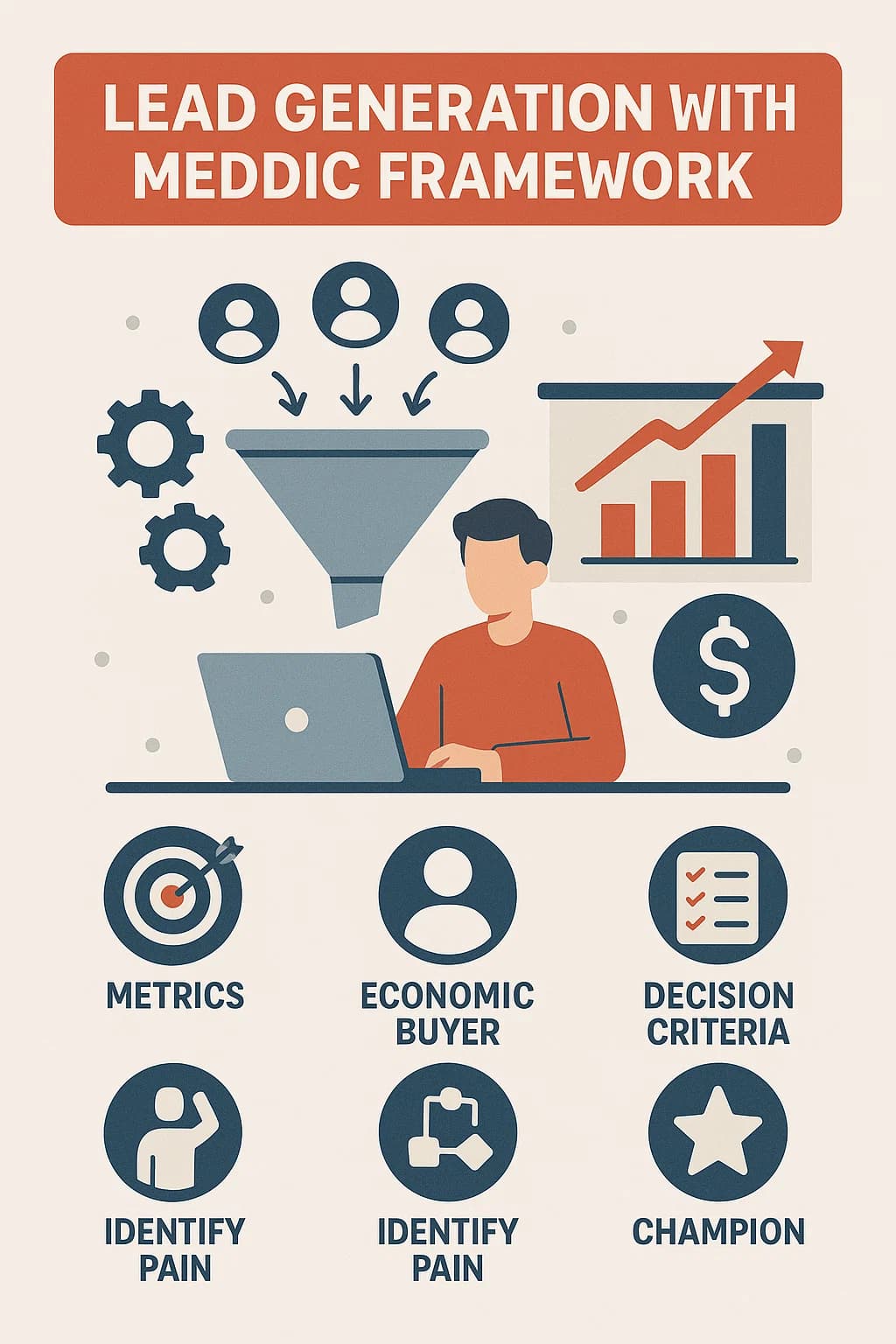
Most sales teams meet the MEDDIC framework late, when an account executive (AE) fills in the letters before a forecast call. By then, weeks have gone into leads that never had a real problem, a reachable buyer or a way to decide. MEDDIC for lead generation moves those questions to the start, before a sales development rep (SDR) hands a lead to an AE.
This guide covers what MEDDIC is, how it compares with BANT and which letters you can research before the first call, plus discovery questions for each letter and a simple score for the SDR to AE handoff.
What is the MEDDIC framework?
MEDDIC is a sales qualification framework: six things you need to know before you can trust a deal. The framework's history on meddicc.com records its origin: "MEDDIC was created in 1996 inside PTC by Dick Dunkel, working under SVP John McMahon alongside teammate Jack Napoli." The same page says PTC took its sales org from $0 to $1 billion in ten years, and that a deal's success or failure could be traced back to six areas:
- Metrics. The measurable value of your solution, in the buyer's own numbers.
- Economic Buyer. The person with overall authority to approve the purchase.
- Decision Criteria. How the buyer will judge your solution against the alternatives.
- Decision Process. The steps, people and dates on the way to a decision.
- Identify Pain. The business problem the buyer faces and what it costs them.
- Champion. An insider with influence who actively helps your deal forward.
MEDDICC adds a second C for Competition. MEDDPICC adds Competition and a P for Paper Process: the steps from decision to signature, where deals can stall in legal review, security sign-offs or vendor questionnaires. For lead generation, the original six letters are enough.
Why use MEDDIC in lead generation, not only in late-stage deals?
Because the reasons deals die late are usually visible early. A lead with a vague problem, one friendly contact and no idea who signs looks fine in week one and stalls in month four.
In a Gartner survey of 632 B2B buyers conducted in 2024, buying groups typically included 5 to 16 people, and 74% of buyer teams showed unhealthy conflict during the decision: conflicting objectives, disagreement on the best course of action, or being overruled by external decision-makers. Groups that reached consensus were 2.5 times more likely to report that their deal was high quality.
In Harvard Business Review, Dixon and McKenna report, from an analysis of more than 2.5 million recorded sales conversations, that 40% to 60% of deals are lost not to a competitor but to customers who express intent to buy and then fail to act.
MEDDIC at the lead stage will not rescue a stalled deal; our piece on why B2B deals stall with no decision covers that. It keeps weak leads out of the pipeline, so your AEs spend discovery time on buyers with a real problem and a path to a decision.
MEDDIC vs BANT: which is better for lead qualification?
For most B2B IT and SaaS deals, MEDDIC gives the more honest picture. BANT (Budget, Authority, Need, Timeline) is quick and fits simple sales where one person buys from a known budget.
In outbound, BANT assumes a decision to buy that has not happened yet. A prospect you contacted cold rarely has money set aside or a date in mind, so a BANT first call often ends at "no budget" and loses a lead that could have become a deal. MEDDIC starts from the problem and its cost, which is what creates a budget.
| BANT asks about | MEDDIC looks at | What changes on the call |
|---|---|---|
| Budget | Metrics, Economic Buyer | What the problem costs, who funds a fix |
| Authority | Economic Buyer, Champion | Who signs, who sells it internally |
| Need | Identify Pain | A problem with a cost and an owner |
| Timeline | Decision Process | Real steps and dates |
| Not covered | Decision Criteria | How your offer will be compared |
A practical split: a BANT-style fit check decides whom to contact, and MEDDIC evidence decides when a lead is ready for an AE.
Which MEDDIC letters can you research before the first call?
About half, and only as a hypothesis to test on the call. Research gives you a first guess for Metrics, Economic Buyer and Identify Pain, sometimes for Decision Process. Decision Criteria and Champion almost always need a conversation.
| Letter | Research can tell you | Only a conversation reveals |
|---|---|---|
| Metrics | Which numbers matter in their business | The actual figure and the target |
| Economic Buyer | The likely role, sometimes the name | Who really approves |
| Decision Criteria | Hints in job ads or tenders | What they compare, and what weighs most |
| Decision Process | Parent company, procurement rules | Steps, people and dates |
| Identify Pain | Triggers: hiring, funding, a new leader | Whether the pain is real, costly and owned |
| Champion | People who engaged or posted about the problem | Whether they will open doors for you |
A pre-call research checklist for SDRs
Give each account 10 to 15 minutes, not an hour: enough for a sharp first message and three good questions.
- Confirm the fit. Industry, size, country and technology against your ideal customer profile; our guide to IT sales leads shows how to build one.
- Find one trigger. A new leader, a funding round, a hiring push or a new system. LinkedIn Sales Navigator filters by role and recent job changes, Crunchbase tracks funding and BuiltWith shows the technology behind a website. Signal-based selling turns this into a routine.
- Write a one-sentence pain hypothesis. Say you sell a service desk tool: a company hiring three support technicians at once probably has a ticket backlog that hurts resolution time.
- Map three people. The likely economic buyer, someone who lives with the problem and a possible champion. With buying groups of 5 to 16 people, one contact is never enough.
- Note the status quo. What they use today; doing nothing is your most common competitor.
- Log it as assumptions. Hypotheses go into the CRM with their source, marked unconfirmed.
AI can do the first pass: in Salesforce's seventh State of Sales report, sellers said they expect AI agents to cut the time spent researching prospects by 34%. Check the output anyway: a wrong trigger in an opening line ends the conversation.
How to use MEDDIC in outbound messages
Never mention MEDDIC to the prospect. Use it to decide what each message says and whom it goes to.
- First message: the pain. Name the trigger and the problem it suggests, and ask if it is on their list.
- Follow-ups: the metric. Show what the problem usually costs, in numbers they already track.
- Parallel threads: the buying group. The metric goes to the likely economic buyer, the pain to the person who lives with it.
- Replies: evidence. "Not my area, ask Petra in finance" tells you about the Economic Buyer and the Decision Process.
RAIN Group found that it takes an average of 8 touches to get an initial meeting with a new prospect, so give each touch a new reason and mix email, LinkedIn and phone. For email, why cold emails go to spam covers what mailbox providers check.
MEDDIC discovery questions for the first call
Confirm two or three letters on a first call, not all six. Start with Identify Pain and Metrics, since they decide whether there is a deal at all.
| Letter | What you need to learn | Example question | Red flag |
|---|---|---|---|
| Metrics | The number that proves success | Which number would show this worked, and where is it today? | No number, just nice to have |
| Economic Buyer | Who approves the spend | Who else would approve a project like this? | Nobody will name the person |
| Decision Criteria | How options will be judged | What matters most when you compare solutions? | A list copied from a rival's brochure |
| Decision Process | Steps and dates to a decision | How did your last similar purchase get approved? | No steps, no dates |
| Identify Pain | The problem and its cost | What happens if nothing changes this year? | A mild annoyance nobody owns |
| Champion | Someone who will act for you | Who else should hear this, and would you introduce us? | Friendly, but offers no access |
If a red flag appears, park the lead politely: learning it in 20 minutes beats learning it in three months. Role-play builds these habits faster than live calls, and IT sales training helps when a whole team needs the same method.
A simple MEDDIC lead score for the SDR to AE handoff
Score each letter 0, 1 or 2 on evidence: 0 is unknown, 1 is assumed from research or hearsay, 2 is confirmed by the prospect in their own words.
| Letter | 1 point | 2 points |
|---|---|---|
| Metrics | Likely metric from research | Prospect named the number |
| Economic Buyer | Role or name identified | Prospect confirmed who approves |
| Decision Criteria | Guessed from similar deals | Prospect said what matters most |
| Decision Process | Steps guessed | Steps and rough dates confirmed |
| Identify Pain | Hypothesis from a trigger | Prospect described the problem and its cost |
| Champion | Friendly, engaged contact | Contact offers access to others |
Hand the lead to an AE at 7 or more out of 12, with Identify Pain at 2 and Economic Buyer at 1 or more. At 4 to 6, the SDR books a second conversation or reaches a second person in the buying group. Below 4, the lead goes back to nurture.
Example: the pain and a target number are confirmed, the prospect names the IT director as approver, the steps are a guess and your contact is friendly. That scores 8, so the lead goes over with notes on what is still unconfirmed. Recheck the thresholds after a quarter against the leads that became real opportunities.
How to keep MEDDIC light so reps do not drown in admin
Six short CRM fields and a score, filled in within two minutes of the call. Anything heavier gets skipped or faked, and Salesforce's sixth State of Sales report found that reps already spend 70% of their time on non-selling tasks.
- One line per letter. What the prospect said, not your interpretation.
- Split by role. The SDR owns Identify Pain, Metrics and a first view of the Economic Buyer; the AE takes the rest, including the paper process.
- Do not force all six. Confirmed pain and a named approver are worth a meeting even if the process is still unknown.
- Use recordings. If you record calls with a tool such as Gong, fill the fields from the call, not from memory.
- Review weekly. Ask which letter was weak in the leads your AEs sent back. Our guide to consistently hitting sales targets shows how weekly numbers connect to quota.
Frequently asked questions
What does MEDDIC stand for?
MEDDIC stands for Metrics, Economic Buyer, Decision Criteria, Decision Process, Identify Pain and Champion. It was created in 1996 inside PTC by Dick Dunkel, working under SVP John McMahon alongside Jack Napoli. MEDDICC adds Competition, and MEDDPICC adds Competition and Paper Process, the steps from decision to signature.
Can SDRs use MEDDIC, or is it only for account executives?
Yes, in a lighter form. Before the first call, SDRs research Metrics, Economic Buyer and Identify Pain as assumptions. On the call, they confirm the pain and at least one number and ask who else is involved. A lead that scores well goes to the account executive, who works out Decision Criteria, Decision Process and the paper process.
Does MEDDIC work for small deals and short sales cycles?
Yes, with less depth. In a short cycle, one call can confirm the pain, the metric and who signs, and that is often enough. The logic stays the same: get evidence that the problem is real and that someone can say yes before you invest time in a proposal.
Bring MEDDIC into your lead generation
MEDDIC works best as a shared language between the people who find leads and the people who close them. If you want it written into your process, our sales strategy development work includes MEDDIC in the sales playbook.
If you would rather have the meetings booked for you, our lead generation service runs the outbound and our full sales cycle service takes deals from discovery to close. Every Sales Engine plan guarantees qualified meetings: meetings that actually take place, with a company matching the ideal customer profile agreed in writing before the start and a decision-maker or influencer present. Plans start at 1,750 euros a month; see our pricing.
Sources and further reading: meddicc.com, who created MEDDIC; meddicc.com, Paper Process in MEDDPICC; Gartner, press release on conflict in B2B buyer teams, May 2025; Harvard Business Review, Stop Losing Sales to Customer Indecision; Salesforce, sixth State of Sales report; Salesforce, seventh State of Sales report; RAIN Group, touches needed for a first meeting; LinkedIn Sales Navigator; Crunchbase; BuiltWith; Gong.