

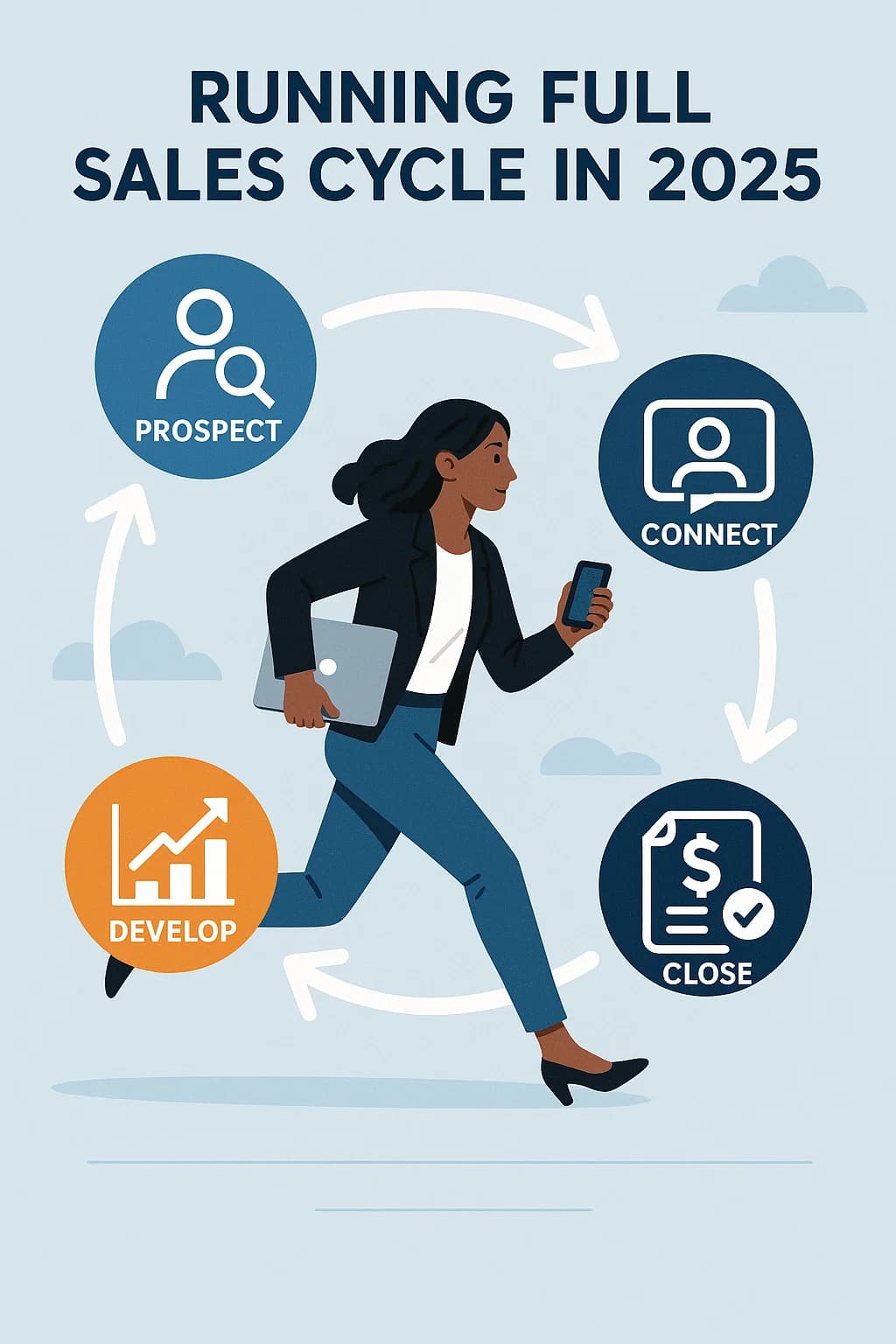
Running the full sales cycle means owning one process from the first cold email to a signed contract and a customer who is live and using what they bought. It does not mean one person doing everything: in many B2B IT companies an SDR, an account executive and customer success each own a part, and the cycle works only if nothing gets lost between them.
Below are the six stages with owners, exit criteria and tools, a handoff checklist, where deals leak and why cycles run long, with the research behind each claim. For the weekly routine of keeping deals moving, see our guide to sales pipeline management.
What is the full sales cycle?
The full sales cycle is every step between choosing a company that should buy from you and a customer who has bought, gone live and is ready to renew. In B2B IT it usually has six stages: targeting, prospecting, discovery and qualification, evaluation, proposal and close, and onboarding with expansion.
The term describes a role or a system. A full-cycle account executive prospects, demos and closes their own deals, which is common when a startup hires its first seller. A full-cycle system splits the work between specialists but runs it as one process, with shared definitions, one CRM and one set of numbers. What fails is the version in between, where each specialist optimises their own stage and treats the handoff as the end of the job.
The stages of the full sales cycle, with owners and exit criteria
Every stage needs a goal, one owner and an exit criterion: a fact that must be true before the deal moves on, such as "the economic buyer agreed to a pilot" rather than "the demo went well". ICP means ideal customer profile, the companies and roles most likely to buy from you.
| Stage | Goal | Owner | Exit criteria | Typical tools |
|---|---|---|---|---|
| Targeting | Accounts worth contacting | SDR | Accounts and roles match the agreed ICP | CRM, LinkedIn Sales Navigator, BuiltWith |
| Prospecting | A first meeting | SDR | Meeting held with a decision-maker or influencer at an ICP account | Email sequences, phone, LinkedIn |
| Discovery and qualification | Confirm the problem and how they buy | AE | Pain, metrics, economic buyer and decision process known | CRM fields, call recording |
| Evaluation | Prove fit to the buying group | AE, with a solutions engineer | Buying group agrees your option solves the problem | Demo environment, pilot plan |
| Proposal and close | A signed contract | AE | Signed, with scope, price and start date agreed | Proposal and e-signature tools |
| Onboarding and expansion | A customer who renews and grows | Customer success | Agreed success metrics met, renewal planned | CRM, onboarding plan, usage data |
Rename the stages to fit your market, but keep two rules: each stage has exactly one owner, even when several people help, and a deal never moves on an opinion.
In discovery, many IT sales teams use MEDDIC: Metrics, Economic Buyer, Decision Criteria, Decision Process, Identify Pain and Champion. MEDDICC's history of the framework says it was created in 1996 inside PTC, and our guide to lead generation with the MEDDIC framework turns it into questions you can check off.
Who owns each stage: SDR, AE or a full-cycle rep?
The SDR (sales development representative) owns research, first outreach and a qualified first meeting. The AE (account executive) owns the deal from discovery to signature. Customer success owns onboarding, adoption, renewal and often expansion.
Specialists get very good at one job, but every handoff can lose context. A full-cycle AE avoids handoffs but has less time to prospect, and prospecting is slow: RAIN Group's research found it takes an average of eight touches to get an initial meeting with a new prospect.
Split off prospecting when your AEs spend more time chasing first meetings than running deals, and customer success when renewals start eating into new business. Each split is also a hiring commitment: The Bridge Group's 2025 research, based on 351 B2B companies, found an average SDR ramp of 3.0 months and median attrition of 40%.
How to hand off a deal from SDR to AE to customer success
A good handoff lets the next owner continue the conversation without making the buyer repeat themselves. Write it in the CRM, in the same fields every time, and let the receiving owner accept or reject it. For the SDR to AE handoff, capture:
- Why this account, and why now: the trigger behind the outreach, such as a new hire or a tool they want to replace.
- Who attended and what they said, in their own words about the problem.
- What was promised, such as a case study or a technical call.
- What is still unknown, such as the budget owner or the timeline, so the AE asks instead of guessing.
The AE to customer success handoff adds what decides the renewal: the success metrics agreed during the sale, every promise about scope or timing, and the names of the economic buyer and the daily users. A short joint call where the customer confirms the goals prevents the classic complaint: this is not what we were sold.
Measure handoff quality by the share of meetings and deals the next owner accepts. If AEs keep rejecting SDR meetings, fix targeting, not the AEs.
Where deals leak in the full sales cycle
Deals rarely vanish in one dramatic moment. They leak at predictable points, most of them on a stage boundary.
- Outreach that stops too early. In Instantly's 2026 cold email benchmark, 42% of replies came from follow-ups rather than the first email.
- Booked meetings that never happen. In Martal's appointment setting example, a team costing USD 24,000 a month that books 20 meetings pays USD 1,200 per booked meeting, USD 1,600 per meeting actually held and USD 2,667 per qualified meeting.
- The wrong person in discovery. A friendly user with no budget can keep a deal alive for months without it moving.
- One contact in evaluation. A Gartner survey of 632 B2B buyers found that 74% of buyer teams show unhealthy conflict during the decision, and Gartner notes that buying groups typically include 5 to 16 people.
- No decision at the proposal. Matthew Dixon and Ted McKenna analysed more than 2.5 million recorded sales conversations and found that 40% to 60% of deals are lost not to a competitor but to buyers who express intent to buy and then fail to act, as they reported in Harvard Business Review.
- A slow start after signature, which puts the renewal at risk.
Late-stage stalls have their own playbook, covered in our guide to why B2B deals stall in no decision.
How long is a B2B sales cycle, and why does it take so long?
There is no honest single number. A small tool bought by one team can close in weeks; a platform that touches security, finance and several departments can take many months. What stretches the cycle is usually the number of people who must agree, not the product.
- First meetings take persistence. At RAIN Group's average of eight touches, prospecting alone takes weeks when the touches are sensibly spaced.
- Buying groups are large and divided, as the Gartner figures above show. Every extra stakeholder adds meetings and another chance to say no.
- Indecision takes time. Waiting for buyers who want to act but cannot commit is often the longest stage of all.
- Sellers have less selling time than it looks. Salesforce's sixth State of Sales report, a survey of 5,500 sales professionals, found that reps spend 70% of their time on non-selling tasks.
A hypothetical example: a 20-person SaaS company sells a 25,000 euro annual contract to logistics firms. Two to four weeks to book the first meeting, one to two to qualify, four to eight for evaluation with IT, finance and operations, and two to six for the proposal, legal review and signature add up to roughly two to five months. Your own average days in each stage is the only benchmark that counts.
How to shorten the sales cycle without skipping steps
You cannot make a buying group decide faster, but you can remove the delays you cause yourself.
- Qualify harder in discovery. A deal without a known economic buyer and decision process is not an opportunity yet.
- Reach the whole buying group early. Gartner found that buying groups that reach consensus are 2.5 times more likely to report that their deal was high quality.
- Agree on the path to signature in a one-page mutual action plan that lists every approval step with an owner and a date.
- Give admin to tools. In Salesforce's seventh State of Sales report, sellers expect AI agents to cut the time spent researching prospects by 34% and drafting emails by 36%.
Metrics to track across the full sales cycle
Revenue tells you that something went wrong; stage metrics tell you where. Track these every week with the owner of each stage:
- Conversion between stages, from held meeting to qualified opportunity to closed deal.
- Days in stage against your own average. A deal sitting twice as long as usual needs a decision, not another follow-up.
- Booked, held and qualified meetings, counted separately.
- Handoff acceptance rate from SDR to AE and from AE to customer success.
- Win rate and cycle length by lead source.
- Time to first value after signature, owned by customer success.
Our guide to sales pipeline management covers the weekly review itself, and how to consistently hit sales targets turns a quota into weekly activity numbers.
Should you run the full sales cycle in-house or outsource it?
You can staff every stage yourself, outsource part of the cycle or outsource all of it.
- All in-house suits deep technical selling and a company ready to build a permanent team. Budget for ramp and turnover: Leadium puts a US in-house SDR at USD 140,000 to 160,000 per productive year once salary, benefits, tools, management overhead and replacement are counted.
- Outsourced prospecting, in-house closing is a common split: an outside team books qualified meetings for your AEs, so the handoff rules matter even more.
- Outsourced full cycle fits testing a new market, language or segment before hiring locally. Agree up front who owns the CRM, the domains and the data.
Either way, define a qualified meeting in writing and count held meetings, not booked ones. See our comparison of outsourced sales vs an in-house SDR and what B2B sales outsourcing costs in 2026.
Frequently asked questions
What does full sales cycle mean?
It means one process that covers every stage of a sale, from targeting and first outreach through discovery, evaluation and close to onboarding and expansion. It can describe one full-cycle rep who does all of it, or a team of SDRs, AEs and customer success managers who run the stages as one system with written handoffs.
What is the difference between an SDR and a full-cycle AE?
An SDR researches accounts, runs first outreach and books qualified meetings for an account executive. A full-cycle AE also runs discovery, demos, negotiation and close. Full-cycle roles avoid handoffs and suit early-stage teams; split roles scale better once prospecting takes more time than one seller can give it.
How long does a B2B IT sales cycle take?
It depends on the deal size and on how many people must agree. Gartner reports that B2B buying groups typically include 5 to 16 people, and RAIN Group found that it takes an average of eight touches just to get a first meeting. Use your own average days in each stage as the benchmark.
Can you outsource the full sales cycle?
Yes. Some companies outsource only prospecting and keep closing in-house; others hand the whole cycle to an outside team, often to test a new market or language before hiring. Agree in writing on what counts as a qualified meeting, who owns the CRM and data, and how closed deals reach your team.
Get help running your full sales cycle
A full sales cycle works when every stage has one owner, every handoff is written down and every deal moves on facts. That is the work we do for IT and SaaS companies. Our full sales cycle service runs deals from first outreach to close, including pipeline management, and lead generation covers the prospecting stages if you keep closing in-house.
If the stages themselves need rebuilding, sales strategy development starts with the ideal customer profile and playbook, and IT sales training helps your team practise discovery and handoffs. Plans start at 1,750 euros a month with guaranteed qualified meetings; see our pricing page.
Sources and further reading: Gartner, buyer team conflict survey, May 2025; Harvard Business Review, Stop Losing Sales to Customer Indecision; RAIN Group, touches needed for a first meeting; Salesforce, sixth State of Sales report; Salesforce, seventh State of Sales report; The Bridge Group, SDR Models, Motions and Metrics 2025; Instantly, Cold Email Benchmark Report 2026; Martal, appointment setting cost; Leadium, outsourced SDR cost in 2026; MEDDICC, who created MEDDIC.