

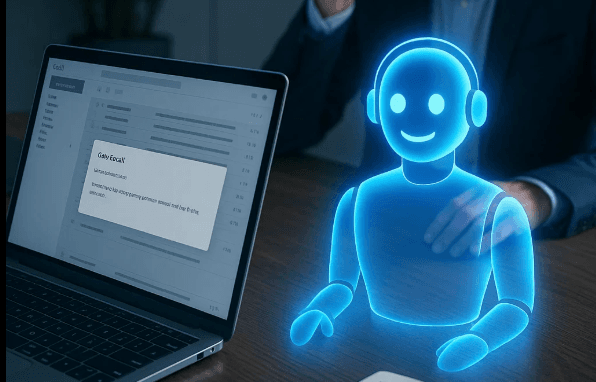
An AI sales agent is software that researches prospects, drafts outreach and takes actions such as sending an email or updating your CRM, with a language model choosing the next step. In 2026 you can build a first version of your own with a model API or a workflow tool, or buy one that runs inside your CRM.
Building it is the easy part. Running it on clean data, within EU rules and without burning your domain is where the work and cost sit. Here is what each path takes, plus a decision table.
What is an AI sales agent?
Salesforce's AI sales agent page defines it as software that understands and responds to inquiries, then takes action without human intervention. The action is what separates an agent from a writing assistant.
Under the hood it is tool use, also called function calling. OpenAI's documentation describes it as a way for models to interface with external systems and access data outside their training data; in Anthropic's documentation, the model returns a structured call that your application executes.
In Salesforce's seventh State of Sales report, a survey of more than 4,000 sales professionals in 22 countries, 54% of sellers said they had used AI agents, and nearly 9 in 10 plan to by 2027. The real question is how much autonomy to give one:
- Assistant: it researches and drafts; a person decides and sends.
- Agent with approval: it prepares actions; a person approves anything that reaches a customer.
- Autonomous agent: it acts alone within limits you set; a person checks samples afterwards.
How to build your own AI sales agent: three routes
They differ mainly in how much engineering you own afterwards.
- A model API plus your own code. Your developers connect a model to your CRM, data sources and mailboxes and write the loop that runs it. You control every step and where the data goes, and you own every bug, update and security review.
- A workflow tool with an AI step. n8n's AI Agent node, for example, connects a chat model to tools and lets the agent decide which ones to call. n8n can also be self-hosted on your own infrastructure, which helps if prospect data should stay on your servers.
- An agent builder inside your CRM. Salesforce and HubSpot let you configure their agents with your own instructions, data and approval rules: less control, far less engineering.
The first two routes mean building what Salesforce's Hunter product page describes as the layer of context, skills and guardrails an agent needs for sales work: your sales methodology, CRM connections, task skills such as account research, and approval rules. The model is the smallest part.
How much does it cost to build an AI sales agent?
The model is usually the cheapest line. People, data and sending infrastructure cost more. Tool prices change often, so here are the categories to price, not the prices.
| Cost category | What drives it | In a bought agent |
|---|---|---|
| Model usage | Tokens per task | Included or billed as usage |
| Hosting or workflow plan | Servers, monitoring, plan limits | Included |
| Contact and intent data | Records enriched and refreshed | Varies by vendor |
| Domains and inboxes | Sending volume, warm-up | Still yours |
| Build and maintenance | Engineering time, model changes | Mostly the vendor's |
| Human review | Daily reading of drafts and replies | Still yours |
Usage billing is common on both sides. Anthropic prices tool use by input and output tokens, and HubSpot's documentation says HubSpot Credits are consumed when its prospecting agent generates personalized outreach for each lead.
Then compare the total with people. Leadium's 2026 breakdown puts a fully loaded in-house SDR in the US at USD 11,700 to 13,300 a month and outsourced SDR programs at roughly USD 3,000 to 14,000. Our plans start at 1,750 euros a month for 5 guaranteed qualified meetings, as our pricing page shows. Count the review and maintenance hours before you call the agent cheaper.
What data and CRM setup does an AI sales agent need?
An agent does not know that a contact left in spring or that an account is a colleague's open deal. It acts on what your CRM says, at scale.
In the same Salesforce survey, 51% of sales leaders with AI said disconnected systems are slowing down their AI initiatives. In Europe, only 28.51% of EU enterprises used CRM applications in 2025, according to Eurostat.
Before any agent goes live, you need:
- A written ideal customer profile (ICP): industries, company sizes, countries, roles and buying triggers.
- Clean records: no duplicates, key fields filled in, and customers, open deals and competitors flagged.
- One suppression list of everyone who objected or unsubscribed, shared by every rep, tool and agent.
- The source and legal basis of every contact.
- Approved product facts the agent may use, and nothing else.
- Outcomes logged back: replies, meetings held and opportunities.
If the ICP is the gap, start with sales strategy development. Our guide to IT sales leads covers sourcing and qualification.
What should an AI sales agent be allowed to do on its own?
Research and drafts, yes; anything that reaches a customer, not until it has earned it. The OWASP Top 10 for LLM applications calls the risk excessive agency, meaning damaging actions taken on unexpected, ambiguous or manipulated model output, and recommends minimal tools and human approval of high-impact actions.
- Least privilege. The agent reads the CRM and creates drafts; sending, deleting records and changing deal stages need approval.
- A person on the first touch. Instantly's 2026 benchmark found that 58% of replies come from the first email in a sequence, so a human edit counts most there.
- No instructions from outside. Text in the websites, files or emails an agent reads can alter its behavior, which OWASP calls indirect prompt injection. Treat it as data, never as instructions.
- Volume limits. Google's sender guidelines ask senders to keep the user-reported spam rate below 0.1% and never reach 0.3%. They cover personal Gmail accounts, not Google Workspace, but treat them as the floor; see why cold emails go to spam.
- No LinkedIn automation. Section 8.2 of the LinkedIn User Agreement rules out bots or other unauthorized automated methods to add contacts or send messages. The agent drafts, a person sends.
- A log and a stop switch, with a named owner who reviews the log weekly.
Where people still beat agents is covered in our task-by-task comparison of AI agents and human reps.
EU AI Act and GDPR: what changes when you build your own agent
When you buy, the vendor is usually the provider under the EU AI Act. When you build, you probably are: Article 3 of the AI Act defines a provider as anyone that develops an AI system, or has one developed, and puts it into service under its own name, and the Commission's guidelines on Article 50 of 20 July 2026 cite a company's in-house chatbot as an example.
Article 50, which applies from 2 August 2026, requires AI that interacts directly with people to be designed so they know it is AI, unless that is obvious, at the latest at the first interaction. Agents, the guidelines add, must disclose that they are artificial and on whose behalf they act, for example with an AI label on the email. Drafts that a person properly reviews and sends fall outside the duty; the mere possibility of review does not. The guidelines are non-binding; our EU AI Act guide for sales teams has more.
Under GDPR, three points matter most:
- Legal basis. Recital 47 says direct marketing may be regarded as a legitimate interest, which still needs a balancing test and an easy opt-out.
- Objections. Under Article 21, anyone can object to direct marketing at any time, and the right must be pointed out at the latest in the first communication.
- Processors. A model API or workflow cloud that handles prospect data for you needs a contract under Article 28, and transfers outside the EU must meet Chapter V.
In the Czech Republic, Act No. 480/2004 Coll. also requires prior consent for commercial email, companies included, with an exception for existing customers, as the Czech data protection office explains. This is not legal advice; check your setup with counsel.
Buying an AI sales agent: what HubSpot and Salesforce offer
Buying means configuring an agent that your CRM vendor builds and maintains. You still bring the ICP, the data and the message.
- HubSpot prospecting agent. According to HubSpot's documentation, it identifies good-fit companies from real-world triggers, sources contacts and generates personalized outreach from CRM data and signals, with each message either reviewed by you first or sent automatically.
- Salesforce Agentforce and Hunter. Salesforce offers prebuilt sales agents inside its CRM. Hunter, its long-running outbound agent, can require rep approval before actions that reach a customer, and every action is logged. See what to fix before an outbound agent goes live.
Salesforce's FAQ says you can create your own sales AI agent, but recommends its platform over do-it-yourself AI. A pitch, yet a fair point: the platform includes integration, security and upkeep you would otherwise build. Stand-alone AI SDR tools are a third option, compared in AI SDR or outsourced sales team.
Build or buy an AI sales agent? A decision table
Find the row closest to your situation.
| Your situation | Best option | Why |
|---|---|---|
| In-house developers, strict data rules | Build on a model API or workflow tool | Full control, if you can maintain it |
| Clean data in HubSpot or Salesforce | Configure your CRM vendor's agent | Integration and updates included |
| No written ICP, messy CRM | Neither yet: fix the data first | An agent repeats what the data says |
| Small team, nobody to review output | Outsource to a sales team | Review and accountability included |
| Email needs prior consent, as in Czechia | Agent for research, people for outreach | Phone and LinkedIn carry the first touch |
| Proven playbook, ready to scale | Buy first, build the gaps | Faster start, custom work only where needed |
Whichever row fits, pilot one agent in one segment with approval on, compare qualified meetings with a human baseline, and build only what the product lacks. Our 90-day plan for implementing AI sales tools covers the pilot.
Frequently asked questions
Can I build an AI sales agent without developers?
Partly. Workflow tools such as n8n connect a chat model to your CRM and email with little code, and HubSpot and Salesforce let you configure their agents with instructions and approval rules. You still need someone who understands data quality, permissions and deliverability, because the agent repeats every mistake at scale.
How much does it cost to run your own AI sales agent?
There is no single price. Model APIs bill by input and output tokens, workflow tools by plan or hosting, and data, domains and inboxes come on top. The biggest cost is usually the people who build, maintain and review the agent, so compare the total with an SDR hire or an outsourced team.
Does a self-built AI sales agent have to say it is AI?
If it interacts directly with people, yes. Article 50 of the EU AI Act, applying from 2 August 2026, requires providers to design such systems so people know they are dealing with AI, and a company that builds an agent in-house can be the provider. Drafts a person properly reviews and sends are treated differently. Check with counsel.
Should a small company build or buy an AI sales agent?
Usually buy or outsource first. A small team rarely has the engineering time to maintain an agent and someone to review its output every day. Configure the agent your CRM offers, or work with a sales partner that runs a reviewed process, and build only the steps no product covers.
Build the sales engine before the agent
An AI sales agent speeds up a sales process that already works; it does not create one. The groundwork, a written ICP, clean data, tested messages and a person in every conversation, is what we do for IT and SaaS companies, with outreach in English, Czech and Turkish.
Our lead generation service books qualified meetings, IT sales outsourcing gives you a sales team, and sales strategy development covers the ICP and playbook. Launch costs 1,750 euros a month for 5 guaranteed qualified meetings, Traction 2,900 euros for 10 and Scale 4,900 euros for 15; see our pricing.
Sources and further reading: Salesforce, AI sales agent FAQ; Salesforce, Hunter page; Salesforce, State of Sales 2026; OpenAI, function calling; Anthropic, tool use; n8n, AI Agent node; n8n, self-hosting; HubSpot, prospecting agent; Leadium, outsourced SDR cost; Eurostat, digital economy statistics; OWASP, LLM06 Excessive Agency; OWASP, LLM01 Prompt Injection; Instantly, cold email benchmark; Google, email sender guidelines; LinkedIn, User Agreement; EU AI Act, Article 3; EU AI Act, Article 50; European Commission, Article 50 guidelines; GDPR, Recital 47; GDPR, Article 21; GDPR, Article 28; GDPR, Article 44; ÚOOÚ, Act No. 480/2004 Coll..